2026-04-05
From One-off Scripts to Reusable Systems: Closing the Computational Gap

Computational design works.But how do you make it scale? Computational designers become heros when the can transform their isolated scripts into reusable assets.
Computational design delivers immense power—but the outputs rarely scale. In conversations with firms, a consistent gap keeps coming up: the disconnect between authoring tools like Revit and flexible modeling environments like Rhino or SketchUp.
Whether you’re using Claude or Grasshopper or Dynamo or ShapeDiver or any other rule-driven system or solver, the specialized knowledge for complex cases isn’t widespread across most teams.
What’s needed isn’t another point solution in that chain—it’s a way to extend computational logic beyond the tools and specialists that created it. A way to make it accessible, persistent, and connected to the rest of the workflow without requiring every designer to become an expert in visual scripting tools.
Here are three key ways Skema’s approach is extending the power of computational design
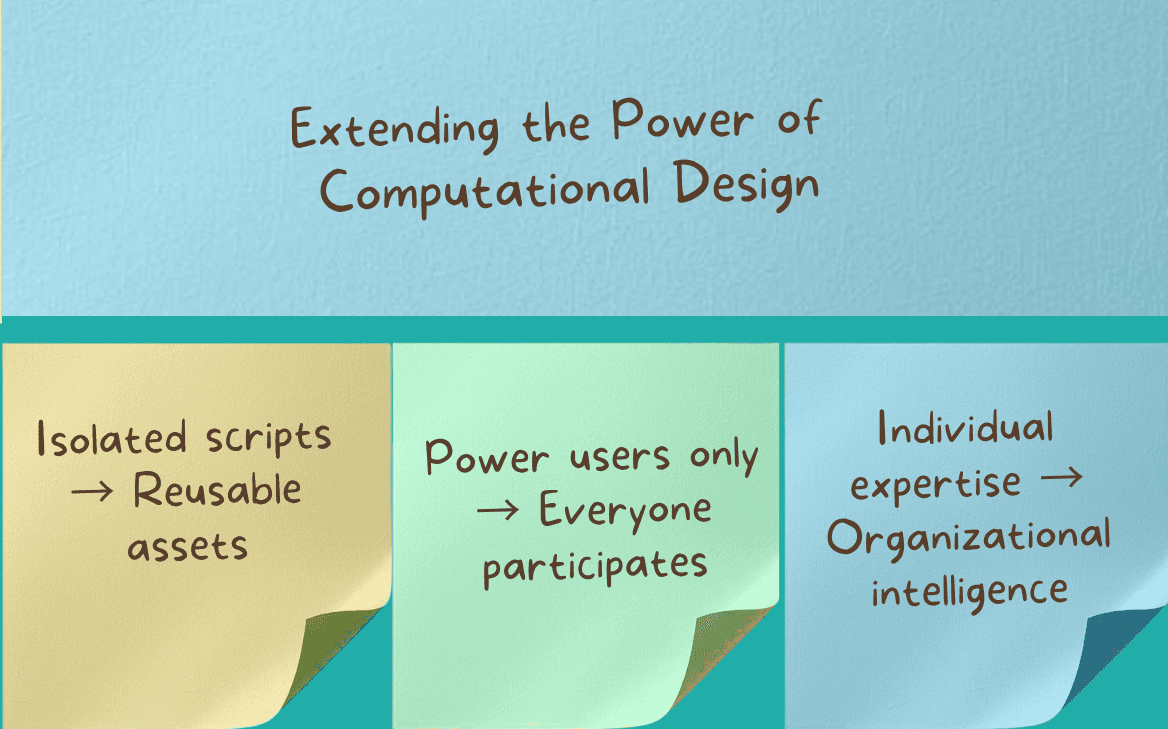
Computation design moves out of the realm of individual expertise and becomes reusable, scalable, and accessible
The future of computational design is taking shape:
From isolated scripts → to reusable assets and continuous systems
From power users only → to everyone participates
From individual expertise → to organizational intelligence
1. From One-Off Scripts to Continuous & Reusable Systems
When the underlying system is built to carry logic forward, not just generate it, you can get a continuous system.
Instead of treating parametric logic as something created and left behind in visual scripting tools, Skema makes design logic accessible so that it becomes part of a broader system—not just reused, but able to be extended, and applied in different contexts.
Logic doesn’t need to be rebuilt from scratch each time. It can evolve and carry forward across projects and phases. It’s a more durable approach.
2. Building Intelligence via The Analytical Model
Skema’s analytic model makes this possible. It’s not just geometry. It’s structured building intelligence—organized by levels, enriched with metadata, and responsive to change.
When you modify a layout, the model updates. When you access it in Grasshopper, you’re not rebuilding geometry—you’re working directly with it. When that same logic is exposed through an API or deployed to a configurator, it becomes usable in entirely different contexts.
This begins to establish a shared language across tools: Skema, Grasshopper, ShapeDiver, Rhino.Inside, Revit.
Design intent is preserved. Not approximated. Not translated. Watch the in-depth YouTube video.
3. Turning Power Users into Heroes in their Office
Skema’s API is designed to make computational capability accessible beyond power users—so more of the firm can participate in it. That shift might be even more important in the context of pressures firm face today.
Through our API, a façade system developed in Grasshopper can become a configurable application. Any designer can use it—even without scripting expertise—through a browser, inside a familiar workflow.
With this approach, firms can see a solution to a long-standing problem: how to scale the value of computational work beyond the people who create it. Each step builds on the last, and computational design is no longer confined to isolated environments.
The Productivity We Need: A Generative Tech Stack That Actually Connects
We’re headed toward a truly connected generative tech stack —one where models, data, logic, and geometry persist and evolve across the lifecycle of a project.
With an API-driven approach, logic becomes portable—able to move through workflows with the model—and becomes the foundation for integrating emerging drivers of productivity like machine learning and natural language processing.
Get a personal briefing on how Skema can help your firm move from script to system, and from isolated workflows to continuous design intelligence
If you’re exploring how to connect computational design, generative workflows, and BIM into a single system, this shift is worth a closer look